Tag: bitcoin

  • Day 2 — Where Did My Bitcoin Actually Go?

    Yesterday we discovered something surprising. It is possible to send money to someone on the internet without a bank acting as the middleman. Instead of relying on a financial institution to verify and record the transaction, Bitcoin uses a global network of computers that collectively maintain a shared ledger called the blockchain.

    But that raises an obvious question.

    When you send Bitcoin to someone, where does the transaction actually go?

    If you send money through a bank, the answer is simple. The bank updates its internal database. Your balance decreases, the receiver’s balance increases, and the bank stores that information on its servers.

    Bitcoin works very differently.

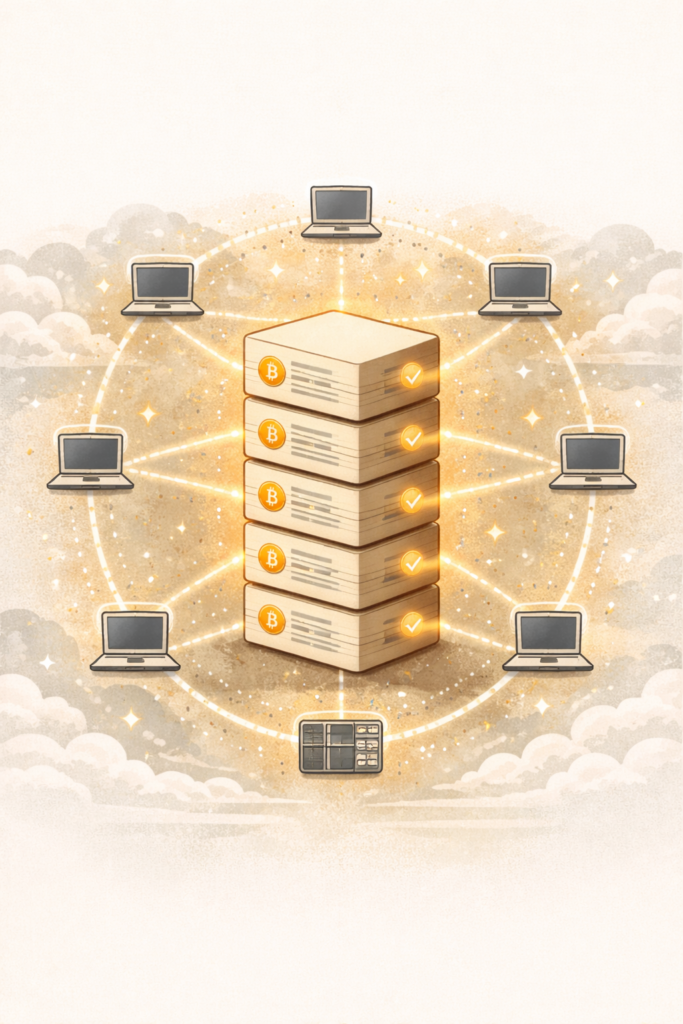
    When you send Bitcoin, the transaction is not stored in a single company’s database. Instead, it is broadcast to thousands of computers around the world that are part of the Bitcoin network. These computers are constantly communicating with each other, sharing information about transactions and maintaining a synchronized record of what has happened on the network.

    To understand this idea more easily, imagine a giant Google Sheet that records every Bitcoin transaction ever made. Anyone can see it, and thousands of computers keep their own copy of it. Whenever a new transaction happens, that transaction is added to the sheet and everyone updates their copy.

    So when you send Bitcoin to Rahul, the transaction is essentially announced to the entire network. The network then records it in this shared global ledger.

    This ledger is what we call the blockchain.

    The word blockchain sounds complicated, but the idea behind it is actually quite simple. It is just a long chain of records, where each record contains a group of transactions. These groups of transactions are called blocks. Once a block is filled with transactions, it is added to the chain of previous blocks. That is why the system is called a blockchain: blocks of transactions linked together in chronological order.

    You can think of each block like a page in a notebook. Every page contains a list of transactions that happened during a certain time period. When the page is full, it is sealed and a new page begins. Over time, these pages form a complete history of everything that has happened on the network.

    What makes this system special is that once a block is added to the chain, it becomes extremely difficult to change. If someone tried to alter an old transaction, they would also have to modify every block that came after it, and they would have to do it across thousands of computers at the same time. That level of coordination is practically impossible, which is why the blockchain is considered highly secure.

    Another interesting aspect of the blockchain is that it is completely transparent. Anyone in the world can look at the Bitcoin blockchain and see all the transactions that have ever occurred. Of course, the identities of the people involved are not directly visible. Instead, transactions are associated with wallet addresses, which appear as long strings of characters.

    This means the system is open and verifiable, yet still preserves a certain level of privacy.

    If we compare this to the traditional banking system, the difference becomes very clear. Bank databases are private. Only the bank has access to them, and you must trust the bank to maintain the records correctly. In contrast, the blockchain is public. The records are shared across the entire network, and anyone can verify them independently.

    This design removes the need for a central authority to maintain trust. Instead of trusting a bank, users trust the transparency and security of the system itself.

    But there is still an important piece missing from the story.

    If transactions are broadcast to the network and stored in blocks, who decides which transactions get added to the blockchain? Who organizes these blocks and links them together?

    This is where a special group of participants comes into play.

    They are called miners.

    Miners play a crucial role in maintaining the Bitcoin network. They collect transactions, verify them, and package them into blocks that become part of the blockchain. In return for doing this work, they receive newly created Bitcoin as a reward.

    In the next post, we will explore how Bitcoin miners operate, why they compete with each other, and how their work keeps the entire network secure.

    Once you understand mining, the inner workings of Bitcoin will start to become much clearer.
  • Day 1 — I Sent Money Without a Bank. Wait… How Did That Even Work?

    A few years ago, if you wanted to send money to someone, the options were pretty limited. You could visit a bank, use internet banking, or send it through an app like Paytm, Google Pay, or UPI. These apps feel very fast and modern, but something important is still happening behind the scenes. Every single transaction eventually goes through a bank. Even if it takes just a few seconds, there is still a bank sitting somewhere in the middle making sure everything checks out.

    Think about what actually happens when you send ₹500 to a friend. It might feel like the money goes straight from you to them, but that’s not really true. Instead, your bank first checks if you actually have the ₹500 in your account. Then it verifies the receiver’s account, confirms that the transaction is valid, and finally updates its own records. In simple terms, you are basically asking the bank to update a database. Your balance goes down, your friend’s balance goes up, and the bank writes this change into its system. That’s how digital money has worked for decades — there was always a trusted middleman keeping track of everyone’s balances.

    Then something unusual happened in 2009. A mysterious person, or maybe a group of people, using the name Satoshi Nakamoto introduced a system called Bitcoin. At first glance it just looked like another kind of digital money. But there was one idea inside Bitcoin that shocked people. It allowed individuals to send money directly to each other without a bank or company acting as the middleman.

    At first this sounds a little impossible. If there is no bank verifying transactions, then how does the system stop cheating? How does it know someone actually owns the money they are sending? And what prevents someone from copying digital money and spending it again and again? These questions confused a lot of people in the early days of Bitcoin, and honestly they still confuse many people today.

    Let’s imagine a simple situation. Suppose you want to send some Bitcoin to your friend Rahul. Instead of opening a banking app, you open something called a crypto wallet. Despite the name, a crypto wallet does not really store money the way a physical wallet stores cash. What it actually stores are cryptographic keys that allow you to control your funds. Without those keys, the Bitcoin can’t be accessed or moved.

    Every crypto wallet generates a unique public address. You can think of this address like an email address, but for money. Anyone in the world can send Bitcoin to that address. The address usually looks like a long string of random characters, which honestly looks a bit strange the first time you see it. But that string simply represents a destination on the Bitcoin network.

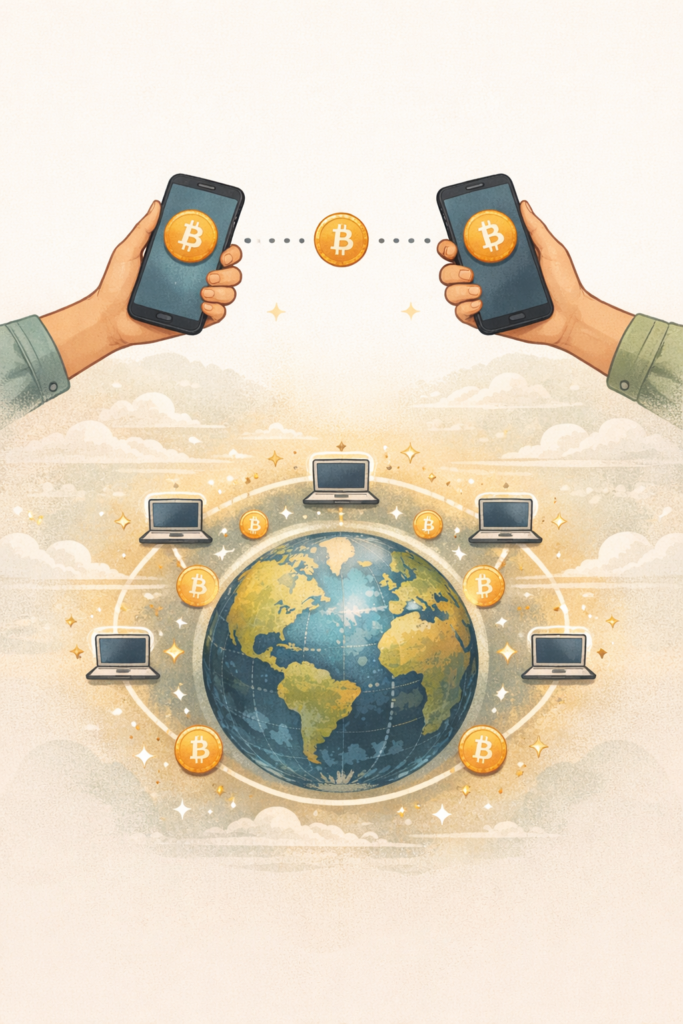
    When you want to send Bitcoin to Rahul, you enter Rahul’s wallet address and the amount you want to send. When you press the send button, your wallet broadcasts the transaction to thousands of computers connected to the Bitcoin network. These computers are spread across the world, and together they form the global Bitcoin system.

    This is where things start to get interesting. Instead of a single bank verifying the transaction, the Bitcoin network relies on many independent computers that collectively check whether the transaction is valid. They check things like whether the sender actually owns the Bitcoin and whether that Bitcoin has already been spent somewhere else. Once the network confirms that everything is correct, the transaction is recorded permanently.

    Where is it recorded? In something called a blockchain.

    You can imagine the blockchain as a giant notebook that keeps track of every Bitcoin transaction that has ever happened. For example, the notebook might contain simple entries like this: Alankrit sent Bitcoin to Rahul. Rahul later sent some Bitcoin to Sneha. Sneha then sent a portion of it to Aman. Over time, this notebook grows bigger and bigger as more transactions happen.

    The remarkable thing is that this notebook is not stored in a single location. Instead, thousands of computers around the world maintain identical copies of it. Whenever a new transaction happens, these copies are updated together. Because so many computers hold the same record, it becomes extremely difficult for anyone to secretly change the history. If someone tried to alter a transaction, their version of the notebook would not match everyone else’s.

    A simple way to understand this is to imagine a classroom where every student keeps their own notebook. Whenever someone transfers money, the teacher announces the transaction and every student writes it down. If one student later tries to cheat by changing their notebook, everyone else will immediately notice because their records won’t match. The system stays honest because many people are keeping track at the same time.

    Bitcoin works in a very similar way, except the classroom is replaced by thousands of computers spread across the globe. Because the ledger is shared and transparent, people who don’t even know each other can still agree on what transactions actually happened.

    For the first time in history, people could send digital money to anyone in the world without needing permission from a bank, a government, or a company. The system runs through open software and is maintained by the participants themselves.

    But this naturally leads to another interesting question. If banks are not verifying transactions anymore, then who is doing that work on the Bitcoin network? And why would anyone spend their computing power helping the system run?

    The answer introduces one of the most fascinating parts of Bitcoin — mining.

    In the next post, we’ll explore how Bitcoin transactions are verified, who the miners actually are, and why they are rewarded with newly created Bitcoin. Once you understand that mechanism, the whole idea of blockchain will start to make a lot more sense.