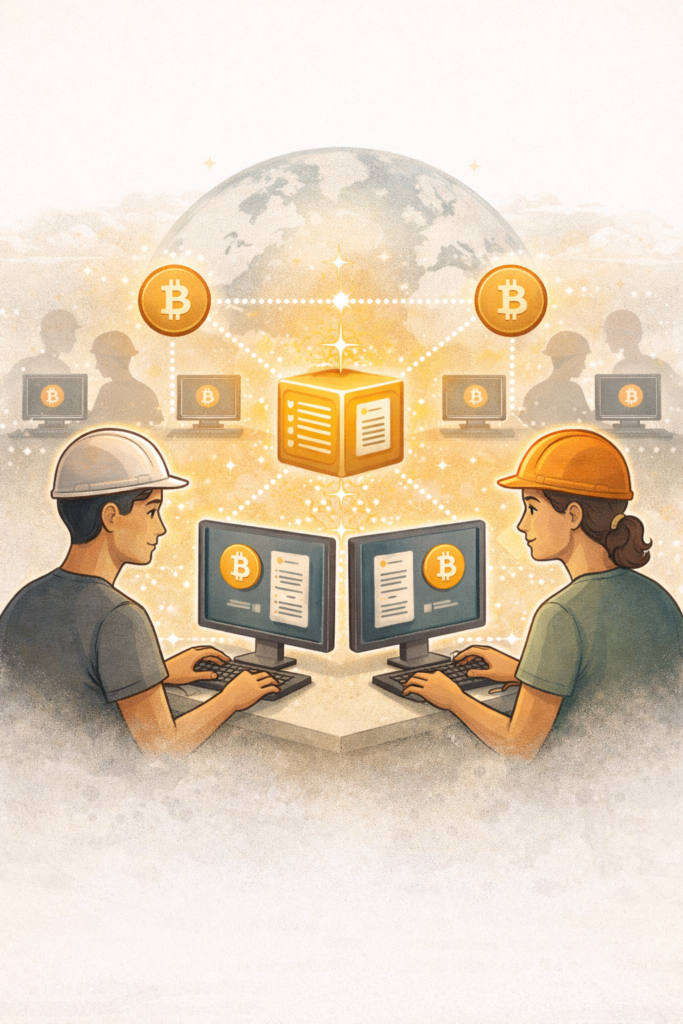
By now something about Bitcoin should start to feel a little bit strange. You send over some cash and it is logged in a global ledger, there is no bank and no one controlling the ledger, and it somehow all still works out. When you take a moment and think about that you will find that there is a nagging, awkward question: since there is no single entity approving the transactions, who is to stop people from cheating?
In the traditional finance world there is always a central party to maintain trust. When you make an electronic transfer over a bank you are trusting that they are confirming you have the balance required, they are also verifying your identity and then the key point they are confirming you don’t double-spend your funds. Without these checks and balances it would be a simple matter for everyone to cheat and so you have a concept known as double-spending where people try to spend the same funds over two separate transactions.
Bitcoin overcomes the double-spending problem in a quite peculiar way. Instead of replacing the central trusting party, they are instead distributing trust over thousands of independent parties. To simplify the idea think about what would happen if you put that many students in a classroom and had no teacher and no leader. Everyone would have their own little notebook where they record their transactions and when one student calls out that they want to make a transaction, all the other students would look in their notebook to verify if that student has enough funds or that it hasn’t already been transferred before. If it hadn’t, the transaction is recorded by everybody.
Scale that up to the entire world and you will start to get a rough idea of how the bitcoin system works with thousands of computers called nodes constantly running and recording each transaction. When a transaction is announced to the entire network these nodes go and check that it isn’t trying to be double-spent or isn’t otherwise illegal, and then everyone adds that to their ledger. However it wouldn’t do any good for nodes to confirm all the transactions, the actual chain needs to be built somehow.
That’s where miners come in. Miners are a specific group of people running on the network, they pick up all of the verified transactions and then try and bundle it into a block and be the one to add it to the blockchain. They don’t add the next block however simply by choosing which one they want it to be and because they want to, it has to be the one that solves a very hard problem. Whoever solves the computational puzzle first is rewarded with the new block (which contains new bitcoin), but the way that it’s done makes it so that only someone with more computational power than the rest of the network combined could manipulate the system.
The problem and the system itself looks slightly convoluted but without both sides of this ‘verification’ and ‘miner’ equation the system wouldn’t work. However there is a more deep layer to all of this. You’ve heard of this computational puzzle the miners have to solve but what is this puzzle exactly and why is it so difficult? The puzzle lies at the center of Bitcoin’s security framework.