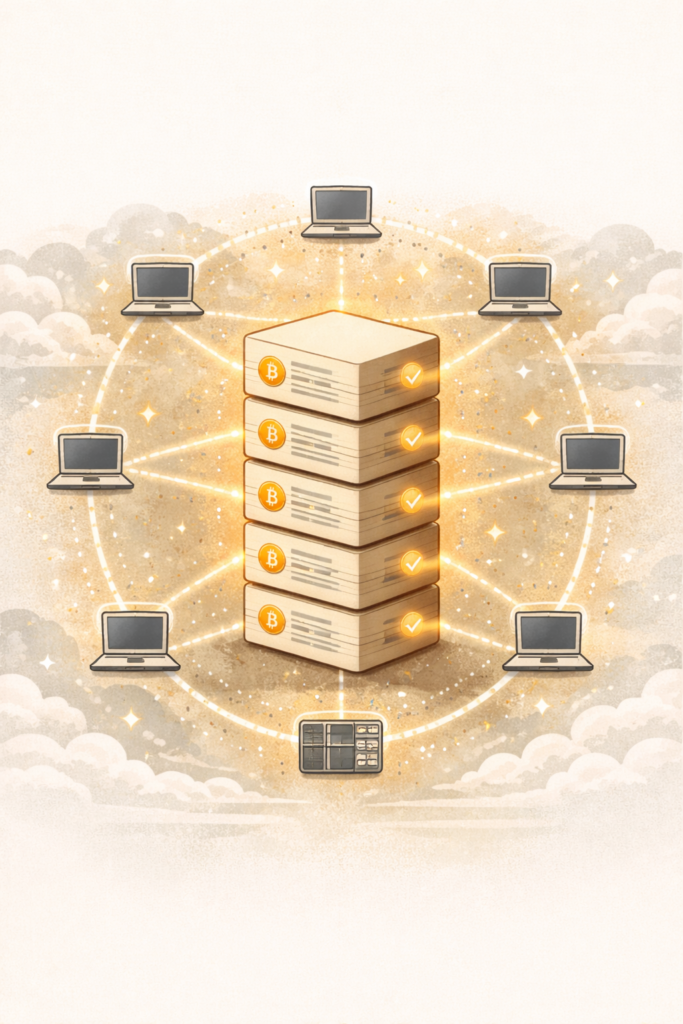
Earlier, we came across an astonishing idea. It is possible to send money through the internet without any banks being involved. Instead of financial institutions verifying and storing transactions, it is through a network of global computers that a public ledger known as the blockchain is formed. It is only natural to ask an obvious question: Where do transactions go when you send Bitcoin to someone?
As the answer is clear for the banking systems, if you make a transaction with your bank it simply adds this record to its own database and decrements from your balance while incrementing the recipient’s balance, all on a central bank server. However, for the Bitcoin network it is quite different. When you send Bitcoins, the transaction is broadcast to thousands of global computers that communicate among each other to maintain synchronized database of transactions.
You could better understand this if you compare it to a Google Sheet where every single transaction of Bitcoin ever is recorded and every participant of the Bitcoin network holds a copy. Whenever a new transaction takes place, it gets added to all thousands of copies of this Sheet. Thus, if you send Bitcoin to your friend Rahul, it is declared to everyone in the network who then updates their copy of the global ledger.
This ledger of all transactions is what is known as the blockchain. There is really nothing fancy about this word other than it represents a chain of records where records containing transactions are added in chunks called blocks. When a block becomes full, it gets added to the previous chain of records which can be said as creating a sequence of entries.
An easy way to conceptualize the blockchain is to consider it as a diary page containing a group of transactions which are recorded after the specific time period expires, it is sealed and another page is started. Collectively, pages form a complete transaction history of the Bitcoin network.
Once a block is formed and added to the chain, it becomes nearly impossible to edit it as the transaction will affect all subsequent blocks too; and that too is practically impossible with so many users in the network to coordinate that change in all of the blocks in the network at the same time. The transactions thus added are made publicly visible, though not linked with actual identities, which means everyone can see the entries on the blockchain and verify its integrity, but not the identities of individuals behind each transaction, rather strings of characters called wallet IDs will be displayed in place of them.
The entire process is completely contrary to banking which uses its own private databases to maintain records which are then verified and managed solely by them. Here, the blockchain, which is public and open to everyone to verify, ensures a network that is transparent yet maintains privacy through a unique system of identity.
But there is a remaining question; how does a particular set of transaction get verified, collected and formed into a block, linked and then recorded into the global blockchain? Well this task is designated to a group of users called miners who in return for their services are given Bitcoin as a reward. They are the ones who collect pending transactions, pack them into blocks and make them accessible to the whole network in return of mining new bitcoins.