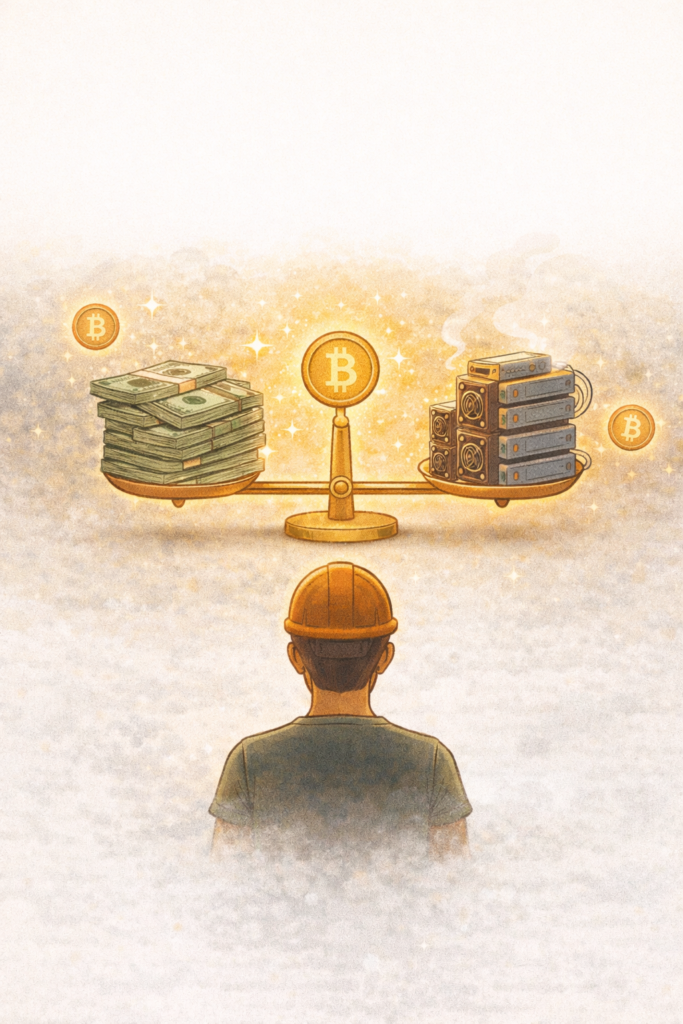
And we have now stumbled across the clever incentive structure at the heart of Bitcoin. As we learned, transactions are verified globally by a network, then added in blocks and appended to the blockchain through a competitive computational puzzle that requires extensive resources (in the form of specialized hardware, constant electricity, and some degree of patience) to solve. It doesn’t take a genius to realize that this leads to an obvious question. Who in their right mind would want to donate these real world resources (time, money, and energy) to operate this system?
The answer comes down to the incentive layer:
Bitcoin is constructed in such a way that participants contributing to the network are financially rewarded for their labor. When a miner successfully solves the computational puzzle and thus publishes their new block of transactions, they receive the reward of freshly created Bitcoins. Added to the reward of newly generated coins, a miner also gets a reward in the form of the transaction fees that their transactions collectively accumulate. These two rewards together motivate miners to expend their computational resources to participate in the system. Without this layer of incentive, it’s hard to imagine someone wanting to waste their resources on a system they don’t own.
The brilliance of this construction is that it makes securing the network an economic activity. Miners are rational, self-interested agents making costs-benefits assessments. They invest in better machines, look for the cheapest source of electricity, and fiercely compete against each other for block rewards because it is the most plausible means to obtain the network’s currency. In doing so, Bitcoin turns security from a technical issue to an economic one. The network’s security relies on the financial interests of the network’s operators, rather than on assumptions about their honest intentions.
To see why this system is so reliable, look at what happens when miners do try to cheat. A miner could include a fraudulent transaction, but once a block is submitted to the network, it will be individually verified by each other node. The block, which violates protocol rules, will be rejected very quickly. The cheated miner ends up wasting their entire computation and electricity expenditure, all for nothing. Miners who follow protocol rules, on the other hand, have a chance to earn rewards. It quickly becomes more economically feasible for miners to behave honestly rather than cheat.
This system ensures the security of the network in yet another way: the larger the amount of computation invested, the more secure the system is. It is exponentially harder to perform enough computation to successfully “fork” the blockchain. This implies that it is far easier for thousands of people running inexpensive, specialized hardware for the benefit of the entire network, rather than for one entity to obtain enough computational power to disrupt the entire network.
Finally, one other fundamental mechanism in Bitcoin to make sure that new Bitcoins are generated at a controlled rate, is its capped supply of new coins. In contrast to traditional currencies where their value is mostly regulated by monetary policy through the creation or destruction of cash (in the form of fiat money) by banks. In Bitcoin, however, new coins enter into circulation as a result of the mining process, and the rewarded number of new Bitcoins is decreased over time,halving itself, and that in turn controls the scarcity and therefore the perceived value.
All in all, this entire system appears to be incredibly well balanced. Economic incentives are driving participation in securing the network, and the strict cryptographic rules guarantee the integrity of the transactions in the blocks. The decentralization of thousands of nodes globally contributes to the agreement on the ledger. Because there’s no trust placed in anyone or any organization, and simply placed in mathematical principles and economic incentives, people on Earth are allowed to engage in mutual agreements concerning a shared financial history without ever knowing each other personally.
With the power and expense of mining growing ever so increasingly, we might start wondering if mining might ever centralize, causing the system to be not so decentralized after all.
In our next post we discuss mining evolution, mining pools and how decentralization could survive against competing, ever-improving technologies.